
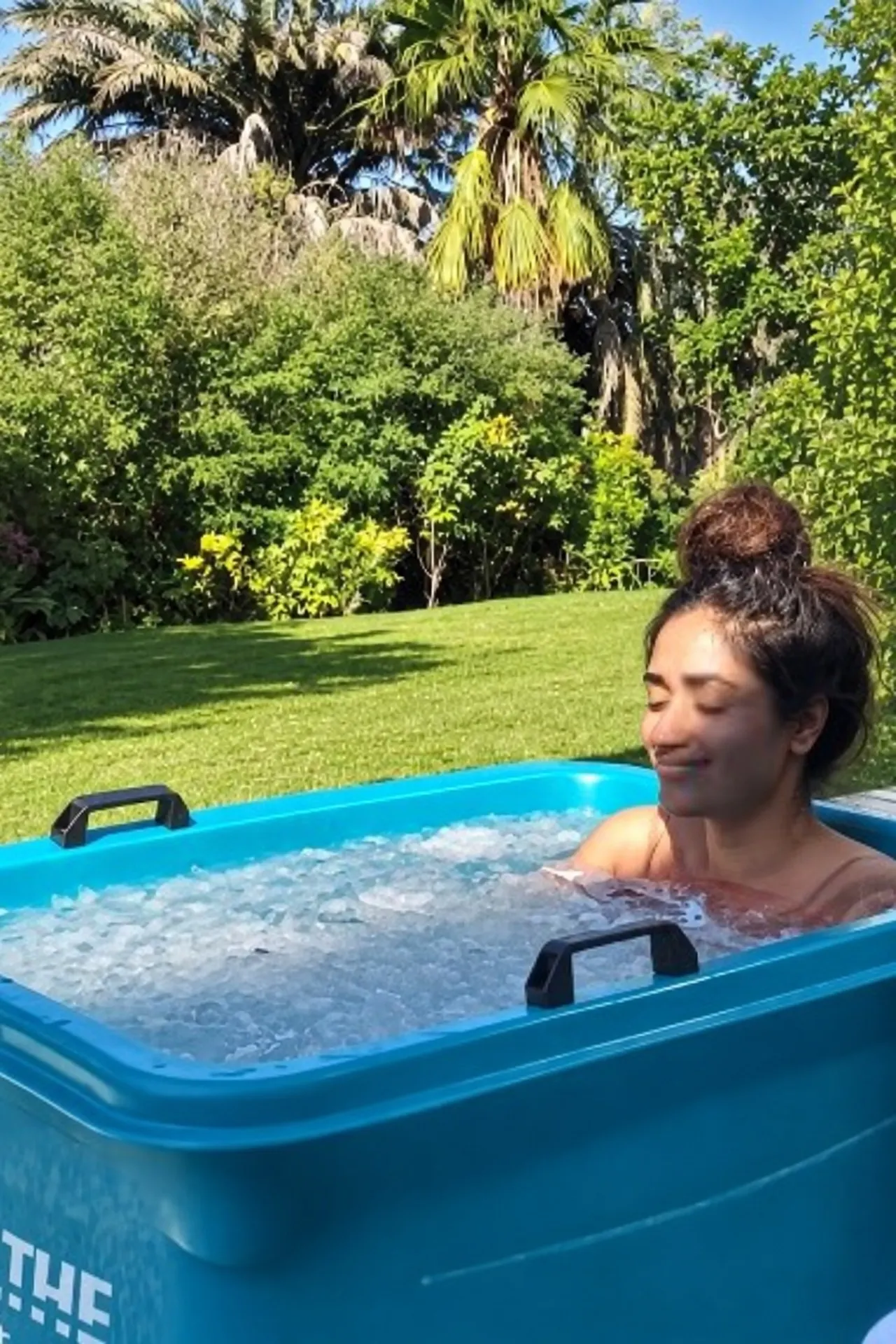
Ice Baths
The Cold Reveals What’s Running The Show
It’s easy to think you know how you’ll respond when life is operating within the boundaries of what you deem comfortable. When there’s still space to make sense of things. Then you step into the cold and logic goes straight out the window. Every instinct in you screams survival. Get out. Make it stop. Do whatever it takes to escape. The shock can bring your rawest, deepest reactions to the surface before you’ve had time to tidy them up or apply logic.
But in this case, you get to watch them. You’re experiencing the reaction and observing it at the same time. You come face to face with the wild animal thrashing inside of you, whose only job is to make sure you survive. And you can’t out thrash the thrashing. You have to meet it differently. And somewhere in the watching, you realize: you don’t have to obey the loudest thing inside you.
The practice isn’t about forcing yourself to stay or proving how tough you are. It’s about meeting yourself when instinct wants to take over and discovering that even there, you still have a choice.
You Might Be Ready To Meet The Cold If:
You don’t have to be fearless, disciplined or someone who loves pushing themselves to the limit. In fact, the cold gets interesting precisely because part of you doesn’t want to be there.
What happens when you willingly meet the part of you that will do almost anything to survive?
When You Want To Expand Your Capacity For What Life Brings
Life can ask a lot of you. Work, relationships, difficult conversations, uncertainty, change. Some things simply take more out of you than you wish they did, especially when several of them hit at once. You want to expand your limits, not barrel past them just to survive. To build your capacity so that what once felt like a lot becomes easier to process, hold and navigate, because it no longer asks quite as much of you.
When You Don’t Want Fear Making The Decisions
Fear doesn’t always announce itself as fear. Sometimes it sounds remarkably like logic, caution or one more perfectly good reason to wait. To fear, different can sound a lot like dangerous. It can be ruthless in what it tells you, even when all it’s trying to do is keep you safe. You want to come face to face with it, learn when you actually need it and when you don’t, and move without automatically letting it make the decision for you.
When You Want More Choice In How You Respond
Sometimes the reaction happens before you’ve even had time to think. You snap. Shut down. Panic. Get defensive. Deflect. Try to take control. Or immediately look for a way out. And sometimes, once the moment has passed, you know that wasn’t actually how you wanted to handle it. You want to catch yourself in that split second between what happens and what you do next, so your first reaction doesn’t automatically become your next move.
When You Want To Step Outside Who You Think You Are
It’s easy to build an identity around what you do and don’t do, what you can handle and what simply isn't you. But how do you know who else you could be if you never step outside the lines of who you think you are? You want to colour outside them, explore the versions of you that might think, act and choose differently, and question if the boundaries you’ve been living within are actually yours.
When You Want To Strengthen Your Bounce Back
Things won’t always go the way you hoped. Plans change. Something falls apart. Sometimes life throws you a curveball and you know in your bones that you need to change course, even when it wasn’t the plan. You want to become more like an elastic band, able to stretch when life asks you to, stay clear enough to meet what’s happening, and find your shape again without snapping under the pressure.
When You Want To Explore What Your Body Can Do
Maybe you’re curious about the physical side of the cold too. Not just what happens in your mind when you step into it, but what your body is capable of adapting to and how it responds when you deliberately ask something different of it.You’re interested in the cold as another way to support your body, your recovery and your physical resilience, not just your mental and emotional experience.
The Cold Doesn't Make The Fear Go Away. It Changes Your Relationship With It.
You step into freezing water and your body doesn’t care about your plans for personal growth. It wants out.
That’s what makes the cold such an interesting place to meet yourself.
Because underneath all the noise, the panic and the instinct to escape, something else becomes possible. You get to see what happens when fear is still there, discomfort is still there, every part of you wants the moment to be different, and you discover you can meet it without abandoning yourself.
And that can change far more than what happens in the water.
1. Fear Can Be There Without Being In Charge
Fear is a trickster. Give it enough authority and, little by little, it can make your world smaller. The conversations you avoid. The chances you don’t take. Fear can keep you still, convincing you that staying where you are is safer than finding out what you can handle. Sometimes fear lives on both sides. What if you reach for what you deeply want and don’t get it? But what if you do, and it takes you somewhere you’ve never been before? Trust that you can meet uncertainty or whatever outcome comes, and fear loses its leverage. It doesn’t have to disappear, or the outcome be guaranteed, for you to move toward what matters. More of your life becomes available when your choices aren’t dictated by what feels safest.

2. You Don't Have To Outfight What's Fighting You
Resistance feeds the thing you’re resisting. You have the original discomfort, fear, emotion or situation. Then you add this shouldn’t be happening, I need it to stop, I don’t want this, and suddenly you’re carrying the original thing plus the fight you’ve created around it. Stop feeding the fight and something can begin to settle. The volume comes down. There’s more quiet. The cold lets you experience that shift in real time. And life gives you plenty of places to practice it. The difficult conversation. The unexpected change. The emotion you don’t want to feel. The situation you wish were different. Less energy spent fighting what’s happening, internally or externally, leaves you clearer about what you’re actually dealing with.
3. You Get To Meet What's Underneath The Reaction
The first reaction can be loud. I need to get out. I can't do this. Make it stop. But as you stay with your breath and the intensity begins to settle, the noise can quiet without you having to think or fight your way out of it. And in that quiet, you can start to notice what the noise may have been drowning out. Fear. Anger. Grief. Something you've been avoiding. Something you deeply want. Or something you've known but haven't been ready to admit. In many ways, what happens in the cold mirrors what happening in your life. What you can't see can still shape who you choose, what you tolerate, what you avoid, what you chase and even what you allow yourself to want. When it becomes visible, you finally have a choice about the relationship you want to have with it.
4. You Discover You Can Watch Without Obeying
The cold gives you a reaction you can’t miss. Get out. Make it stop. I don’t want to be here. But instead of automatically obeying it, you breathe, notice what’s happening and give yourself a moment to decide what actually needs to happen next. Being reactive is human. Sometimes it keeps you safe. But sometimes you’re halfway through snapping, shutting down, spiraling or trying to take control before you even realize something in you has taken the wheel. And sometimes the thing you’re reacting to isn’t bad for you at all. It’s simply uncomfortable, unfamiliar or asking you to grow. The practice isn’t about managing every reaction or becoming perfectly calm. It’s about catching yourself while it’s happening. Not hours later replaying the conversation, but in real time, when you still have a choice. Is this something I need to step away from? Something I want to stay with? Or simply a reaction that doesn’t need to decide what happens next?
5. Discomfort Stops Meaning What It Used To
In the cold, discomfort arrives quickly. Your instinct can tell you, this is too much. My system can’t handle this. But as you breathe, stay present and move through the intensity, you begin to experience the difference between being uncomfortable and actually being unable to cope. With consistency, you bridge the gap between hoping you can handle discomfort and knowing you can. And that matters far beyond the water. Life will stretch you. Growth will too, sometimes through what’s hard and sometimes toward what you deeply want. Sometimes through an emotion you don’t want to feel, an outcome you didn’t want or a change you didn’t choose. Sometimes because something in you knows you’re ready for more, while the human part of you is still scared of where it might lead. The more you experience yourself finding your way through what feels like a lot, the more your capacity expands. You begin to know you can hold yourself through more than you once thought you could.
6. Your Body Learns And Adapts Alongside You
The cold isn’t only something you experience mentally. Your body is responding too. It meets the stress, adapts to what you’re asking of it and then has to find its way back. Cold exposure also creates a real physiological response, affecting everything from metabolism and recovery to aspects of immune function. For some people, the physical side is part of the draw too, particularly when it comes to recovery and muscle soreness. And the way you feel afterwards isn’t always the same. Sometimes there’s energy. Sometimes there’s a deep sense of rest. Sometimes your body simply asks you to slow down and recover. The more you work with the cold, the more you begin to recognize what your body is capable of, how it responds and what it needs from you. And that awareness can follow you into everyday life. When to ask more of yourself. When to recover. When to rest. And when your body might be telling you something your mind hasn’t caught up with yet.
What Actually Happens During An Ice Bath?
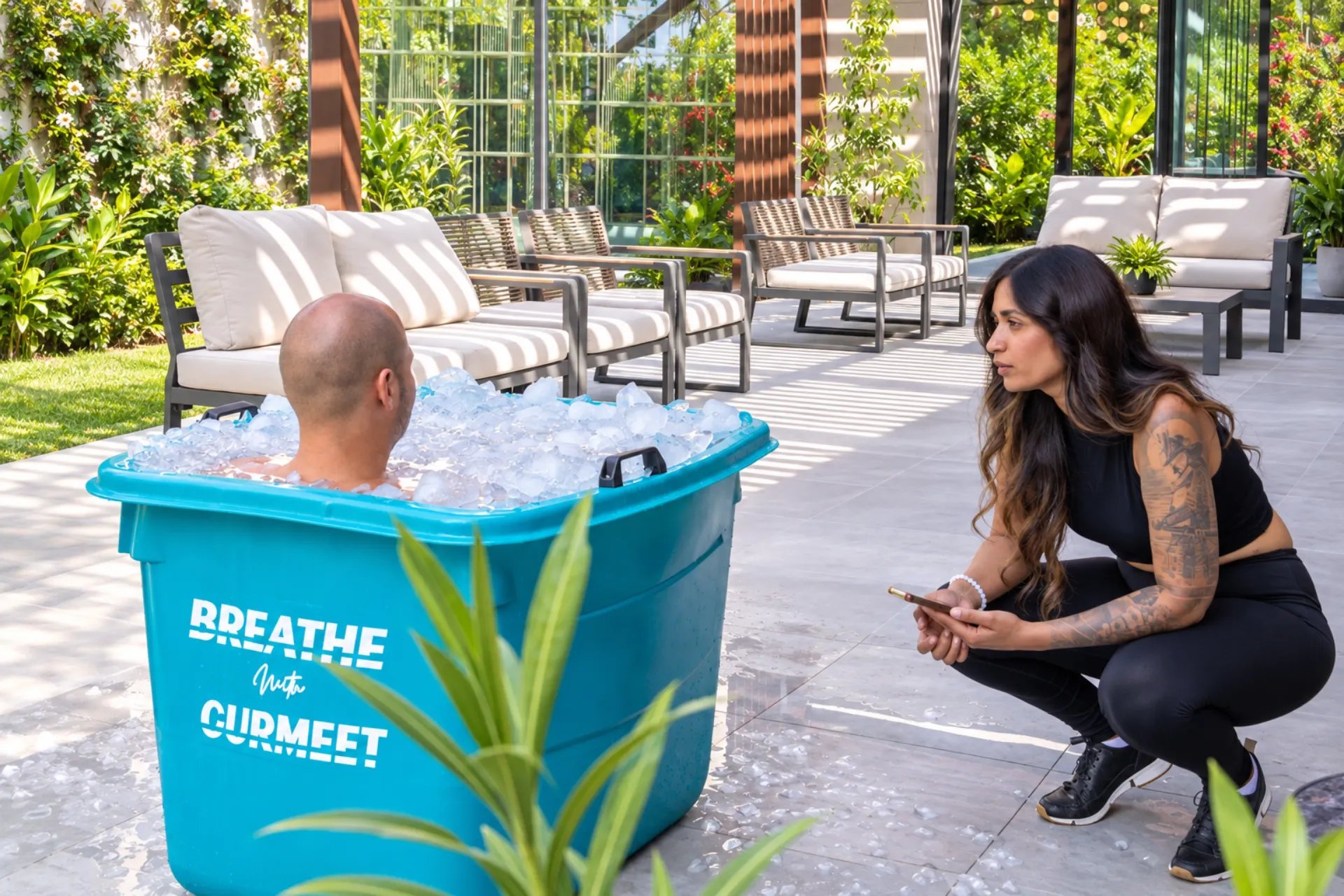
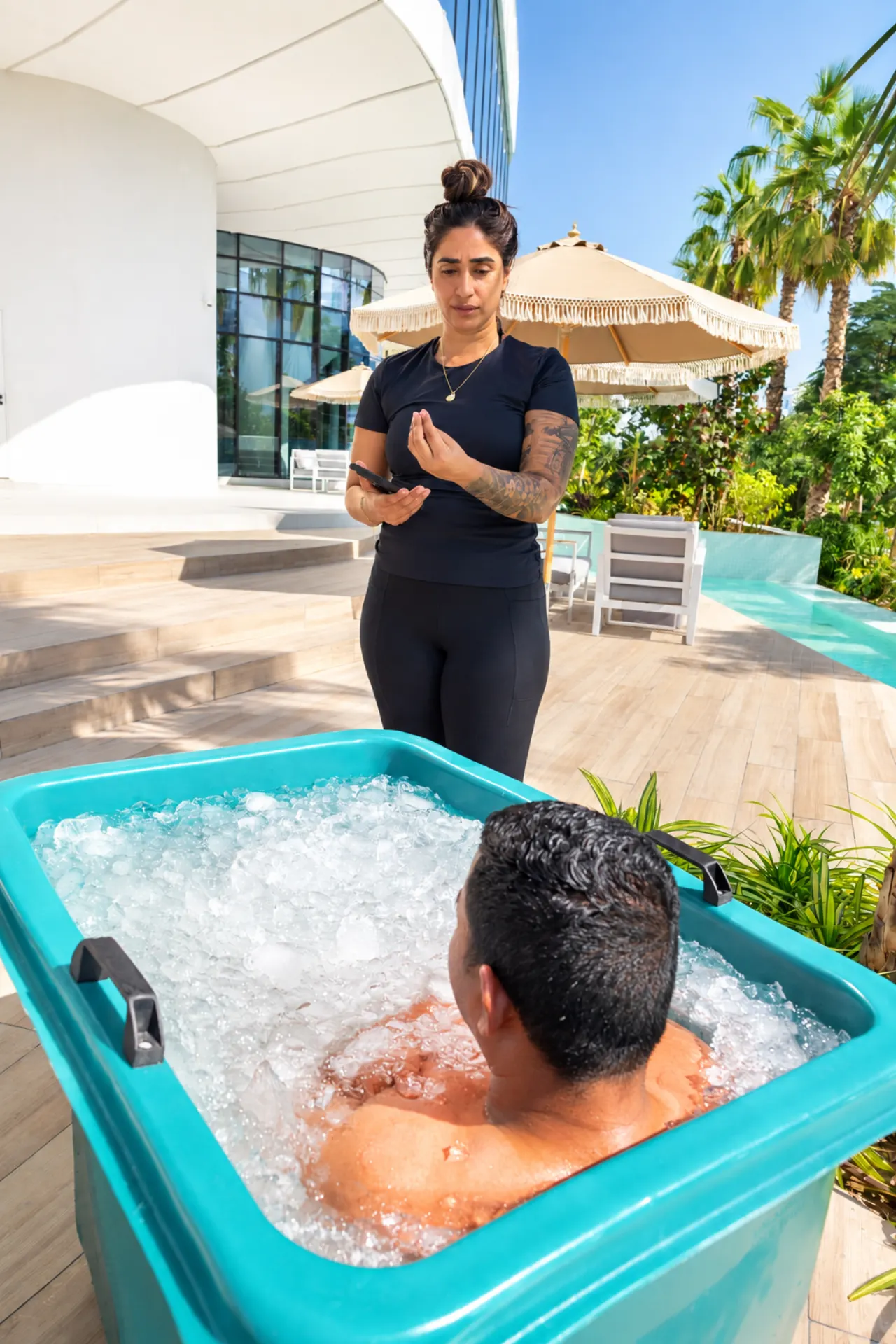
Before you ever step into the water, we talk.
I’ll walk you through what to expect, the mental and physical side of the cold, how we’ll work with your breath and what may begin to surface once you’re in there. But I also want to know why you came. Why this? Why now? What are you hoping to meet, move through or discover about yourself?
Then we stand beside the ice bath together.
We breathe before you get in. And when you step into the water and that first shock hits, I’m right there with you.
That first minute can be loud. Your breath changes. Your body braces. Your mind starts looking for the exit.
And I’ll often give you the live play-by-play.
Here’s what your mind is doing right now. Here’s the trick it’s trying next. Here’s the moment it starts telling you that you can’t do this. Keep breathing. Stay with me.
Because I’ve seen and experienced this first minute enough times to know just how convincing the mind can be when it wants the discomfort to end.
I’m also watching your body. The shoulders creeping toward your ears. The jaw clenching. The hands tightening. All those little places that can involuntarily brace in protection. I’ll ask you to notice them. Soften here. Drop your shoulders. Unclench your jaw. Breathe with me.
Sometimes my hand will be on your shoulder. Sometimes I’ll hold your hand. I’ve even put my own arms into the water with someone because in that moment, they needed to know something very simple:
You are not in this alone. I’ve got you.
And strangely, knowing that can give you permission to let go even more.
Because once the initial fight begins to quiet, something changes. The water hasn’t suddenly become warm. You’re still uncomfortable. But somewhere inside all that noise, you realize: Wait. I’m okay.
That’s the part I love.
Because now we’re no longer just sitting in a bucket of ice.
I may invite you to close your eyes and go deeper. I may ask what you’re feeling. I may notice something you’re trying very hard not to feel and ask you to look at it. There’s no hiding from yourself in this work, but there’s also nothing you’re required to produce for me. Nothing has to come up. But if something does, you don’t have to shove it back down.
Some people need my voice almost constantly. Some need silence. With people I know well, I might ask questions that take them deeper. Sometimes talking would pull you straight out of your breath, so I won’t. I’m reading you, not following a script.
And I’m not standing beside you trying to keep you in the water at all costs.
Sometimes the work is staying when every instinct wants to escape. Sometimes the work is recognizing that your body has had enough and getting out. I’m watching your breath, your body, your reactions and how you’re responding to the experience. There is nothing to prove in that bucket.
And when you finally step out?
The experience is far from over.
Sometimes there’s euphoria. Sometimes relief. Sometimes emotion pours out once the effort of being in the cold is gone. I’ve cried in the water myself, and I’ve cried after getting out.
Your body also has work to do. We keep breathing. We move. We let your arms and legs come back. We give your body the time it needs rather than immediately rushing away from what just happened.
And then there’s the other kind of integration.
What came up in there? What moved? What did you finally stop fighting? What might you have made space for now that something else has loosened its grip?
I don’t want you to walk away thinking the achievement was simply how long you stayed in freezing water.
I want you to leave knowing something about yourself that you didn’t know when you stepped in.
Because the ice was never really the point.
It was what you met inside of it.
Why This Work Became Personal For Me
I found the cold during a time in my life when I was carrying a lot. I was going through a divorce, had packed up my life and moved across the world by myself, and my dad was sick and would quickly pass away. There was more pain in me than I knew what to do with. Part of me was curious about what the cold could open up. If I’m honest, I was mostly looking for relief.
My first ice bath terrified me. I spent the entire time clutching the instructor’s finger, barely able to regulate my breath, staring back like a deer in headlights. I got out and felt lighter in a way I couldn’t explain. Nothing had been solved. I hadn’t talked anything through or figured anything out, and yet something had moved. So I went back.
For the first few months, I cried almost every time. Sometimes the tears started before I even stepped into the water. It was as though my body knew what was coming and was grateful for somewhere to finally let go without having to understand it first. Over time, I’ve met just about every emotion in there. I’ve found clarity and answers, had ideas come out of nowhere, felt deeply peaceful and climbed out completely riled up. Once, I even saw my dad standing right in front of me.
The cold is now an inner oracle for me. A place where all the noise can eventually give way to something quieter underneath. I don’t always have to think my way into an answer. My body knows where to go.
That’s part of why I facilitate this work. I want other people to experience that kind of relief. To go somewhere the thinking mind can’t always take them, and to know they don’t have to do it alone.
The cold is one of the places I meet myself most truthfully. Sometimes I understand what's happening in there. Sometimes I don’t. I don’t need to. I know something is moving. I know something is listening. And I trust that completely.
Working Together
There are a few ways we can work with the cold together.
1. Private Sessions
1:1 sessions shaped around you, what you’re looking for and the kind of experience you want to explore. Available in person or online.
2. Private Groups & Events
Bring ice baths into a private gathering, retreat or event, with the experience shaped around your group and the occasion.
3. Corporate Experiences
Ice baths or events and team building, designed around your people, whether that’s resetting, reconnecting or shifting energy.
If This Resonates With You Let's Start With A Conversation
The Way In is a complimentary 30 minute Clarity Call where we'll explore where you are, what you're moving through, and what kind of support might make sense for you. Together, we'll determine whether coaching, healing, somatic body-led practices, or a blend of approaches would best support your next steps.
You can learn more about the call and what we'll explore together on The Way In page.
If you'd like to book an ice bath session, discuss a private group, event or corporate experience, get in touch.